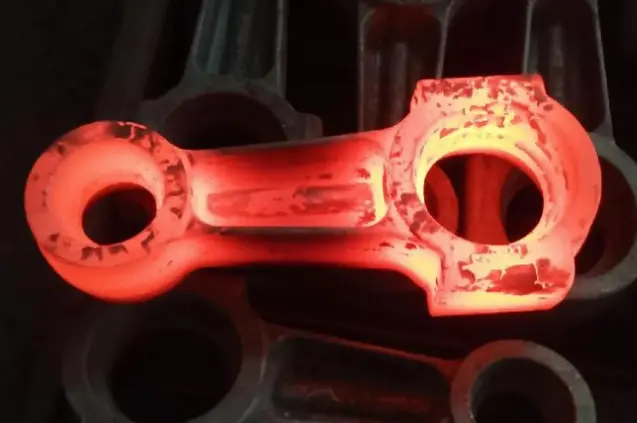
Hoe beïnvloed die oop smeeproses die korrelstruktuur van die materiaal?
Die open die forging process technique is a major factor in determining not only the exterior shape of the metaal deel but also its interior grain structure. Unlike casting, where grains are randomly formed as molten metal cools, open die forging involves the compression and elongation of existing grains, which are aligned in the direction of working. This article explores the effects of deformation, temperature, and pass design on grain refinement, strength, and long-term durability of gesmede dele.

What Happens to Grain Structure During Open Die Forging?
Grain Deformation Under Compressive Force
Repeated compression of the billet between flat or curved dies stretches and flattens the grains along the direction of metal flow. The mechanical treatment breaks up the coarse, as-cast structure of the original ingot and produces a denser, more uniform arrangement. The open die forging technique uses this controlled deformation to remove internal defects before a part ever sees service.
Elimination of Casting Defects
Ingot may have porosity, segregation, and dendritic structure due to incomplete solidification. Repetition working in open die forging leads to a more uniform distribution of alloying elements in the material and the closing of internal cavities. This defect-healing property is one of the main reasons why this process is used in critical applications for massive forgings instead of just casting.
Grain Flow and Microstructure Evolution in Open Die Forging
Directional Grain Flow Along Load Paths
Forged parts are characterised by a directed grain flow, where the elongated grains conform to the shape of the part, rather than being cut by machining. This orientation strengthens the component along its major load-bearing axis. The main goal of engineers in the design of each step of the oop smeewerk proses is to get favourable flow lines.
Herkristallisasie en Graanverfyning
When the temperature of the formation process is high, the deformed grains may generate smaller and strain-free grains, called dynamic recrystallisation. This enhancement enhances toughness and makes brittle failure less likely. It is possible to induce recrystallisation at the proper moment in the sequence by controlling the strain rate and temperature such that the final microstructure is fine and uniform.
How Does Forging Temperature Affect Grain Refinement?
High-Temperature Working and Grain Growth Risk
The higher the forging temperature, the faster the grain boundaries move. If the metal is maintained at that temperature for too long before it is cooled, the grains might develop bigger than required. Workability increases and flow stress decreases with higher temperature, although this must be balanced with the possibility of coarsening, which, if temperature control is not strict, might lead to a weakened final product.
Finishing Temperature and Final Grain Size
The final grain size depends disproportionately on the temperature of the last forging pass. Lower finishing temperatures (within the range of the material’s workability) tend to lock in a finer grain structure because there is less time for grain development to occur before the part cools. Thus, the management of the finishing temperature is seen as a vital checkpoint in any open die forging process.

Can Open Die Forging Improve Strength, Toughness, and Fatigue Resistance?
Enhanced Mechanical Strength Through Grain Alignment
Refined, directionally aligned grains transmit stress more uniformly throughout a component than parts that are just cast or machined, resulting in improved tensile and yield strength. This increase is of particular value for heavy-duty shafts, rings, and rotor smeedstukke, which are required to endure mechanical loads during their design lifetime.
Improved Fatigue and Impact Toughness
There are no sudden pauses in the forged grain flow; hence, parts produced by the open die forging technique often have superior fatigue resistance and impact toughness to cast counterparts. The continuous grain boundaries are less prone to crack propagation and are one of the main reasons why forged components are required for safety-essential rotating and load-bearing equipment.
How Can Pass Design and Deformation Control Optimize Grain Structure?
Strategic Multi-Pass Sequencing
The strain may be more evenly distributed throughout the workpiece by dividing the deformation into many regulated passes rather than one massive decrease. This sequence prevents localised overworking in certain regions and under-deformation in others, and provides a uniform grain structure across the whole cross-section of big forgings.
Managing Reduction Ratio and Strain Distribution
The reduction ratio, or the amount by which the cross-section of a billet is lowered during working, directly controls the degree to which the original cast structure is broken down. Insufficient reduction may leave coarse grains or unhealed porosity near the core, whereas appropriate planning of the reduction ratios during open die forging is essential to provide uniform mechanical characteristics from the surface to the center.

Gevolgtrekking
Open die forging process converts coarse, fault-prone cast structures to fine, directionally oriented grains which provide improved strength, toughness and fatigue resistance. China Welong provides quality control and supply chain services for manufacturers in aerospace, oil drilling, and industrial sectors, certified by ISO 9001:2015 since 2001. In 20 years, we have shipped to 100+ clients. Partner with Welong now for gesmee komponente developed for demanding, high-performance applications.
FAQ
Q1: How is open die forging different from closed die forging in terms of grain structure?
A: Open die forging allows more flexible, incremental shaping, which can produce longer, more continuous grain flow patterns compared to the confined cavity flow of closed die forging.
Q2: Does open die forging always improve grain structure compared to casting?
A: Yes, in nearly all cases, since the mechanical working breaks down coarse cast grains and closes internal porosity, resulting in a denser, more uniform structure.
Q3: What role does reduction ratio play in grain refinement?
A: A higher reduction ratio generally breaks down the original cast structure more thoroughly, producing finer, more uniform grains throughout the part.
Q4: Can grain structure be inspected after forging?
A: Yes, techniques such as macro-etching and metallographic sectioning allow engineers to visually confirm grain flow direction and refinement.
Q5: Why is finishing temperature important in open die forging?
A: Finishing temperature controls final grain size, since lower finishing temperatures reduce the time available for grain growth after the last forming pass.
Source Precision-Forged Components With Welong
Grain structure quality can make or break the performance of critical forged components. China Welong combines two decades of international supply chain experience with ISO 9001:2015-certified quality control and engineering support using AutoCAD, Pro-Engineering, and SolidWorks to help you achieve consistent, defect-free forgings. Whether your project demands large rings, shafts, of persoonlike industriële komponente, our team is ready to guide you from drawing to delivery. Contact us today at metaal@welongpost.com and let Welong strengthen your next open die forging process projek.
Verwysings
1. Amerikaanse Vereniging vir Metale (ASM Internasionaal), Metaalhandboek: Vorming en Smeewerk, Volume 14.
2. Dieter, GE, Meganiese Metallurgie, McGraw-Hill Onderwys.
3. Byrer, TG, Semiatin, SL, en Vollmer, DC, Smeedhandboek, Vereniging van die Smeedbedryf.
4. Altan, T., Ngaile, G., en Shen, G., Koue en Warm Smeedwerk: Grondbeginsels en Toepassings, ASM International.
5. Kalpakjian, S., en Schmid, SR, Vervaardigingsingenieurswese en -tegnologie, Pearson Education.
6. Lange, K., Handboek van Metaalvorming, Vereniging van Vervaardigingsingenieurs.

Share your inquiry, get the quotation accordingly!
China WELONG - Jou betroubare vennoot in metaaloplossings