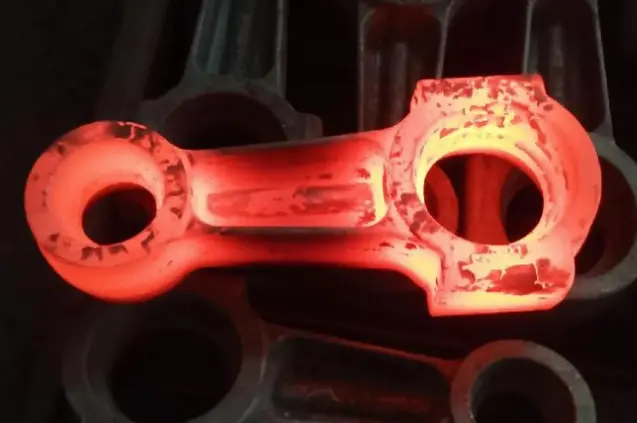
Verskillende tipes smeeprosesse: 'n Ingenieursoorsig
In forging, compressive forces are utilised to deform a workpiece into a desired geometry. Depending on the material, part size, production volumes and dimensional requirements, forging can be performed at hot, warm or cold temperatures. We also use other equipment and die configurations, from reasonably simple open dies to very sophisticated closed dies and ring-rolling systems. Forging is still relevant because deformation may generate a regulated grain flow and dense internal structure while minimising the amount of material that has to be removed compared to making particular geometries totally from bar or billet. These features make the forged parts suitable for use where mechanical properties, repeatability and material utilisation are of importance. Not all components are necessarily suitable candidates for forging, however. It will depend on the material, geometry, tolerances, quantity, tooling investment and any downstream machining requirements as to which is the best path. Knowledge of the distinctions between the three main smeeprosesse is useful for engineers and B2B procurement teams in the evaluation of quotations, comparison of manufacturing routes and identification of suppliers with the correct equipment and process controls.
Understanding How Forging Methods Differ
The basic concept of forging is controlled plastic deformation. A workpiece (billet, bar, preform, etc.) is compressed into a desired shape. The deformation can be done by hammer, mechanical press, hydraulic press, screw press or special purpose forming equipment.
What comes out depends on a lot more than how hard you hit the stuff. The final microstructure and mechanical properties are influenced by the initial billet condition, the amount of deformation, the forging temperature, the strain rate, the die design, lubrication, cooling, and the subsequent heat treatment.
This is why two parts manufactured from the same alloy may have different manufacturing needs. A huge shaft might be made by open die forging because the component requires a large amount of deformation and has a relatively straightforward geometry. Closed die forging may be better suited to smaller automotive components with repeating features, where dedicated equipment can manufacture consistent shapes at higher volumes.
So forging should be understood as a family of manufacturing processes, not a single, standardised operation.
Hot, Warm, and Cold Forming
Temperature is one of the most critical criteria to choose a forging route. Hot forging is performed at a high temperature where the material is simpler to deform. The specific temperature range is alloy-dependent, and the operation must be held in a proper window to prevent difficulties such as excessive oxidation, grain growth or other metallurgical changes.
The warm forging process occurs at a temperature below that of the usual hot-forging settings but above room temperature. It can minimise the forming forces compared to cold forging and give better dimensional control than many of the hot forming processes. It’s not a single universal number but a temperature range, depending on the material.
Cold forging is performed at or near room temperature. It has the ability to provide good dimensional precision and surface finish and can also produce work hardening in suitable materials. However, the pressures involved in forming can be large, and things like the ductility of the material, the strength of the tooling, lubrication and the capacity of the machinery become very critical.
The choice between these temperature ranges should be based on the full manufacturing procedure and not on temperature alone. Machining may be reduced by a technique that provides a near-net-shape component, while another route may require further heat treatment or finishing procedures.
Five Forging Routes Used in Industrial Manufacturing
Different challenges of production are solved by different ways of forging. The best decision relies on the shape of the part, the production volume, the material behaviour, the dimensional requirements and the equipment available.
Open Die Forging for Large and Low-Volume Parts
Open die forging, where the dies do not entirely surround the workpiece. The material is shaped and pressed between very simple die surfaces, often by means of several deformation processes. The workpiece can be moved or repositioned during the process to get the appropriate size and shape.
The great thing about this approach is that it is flexible. Open die forging is economically attractive for large components, prototypes, development parts, repair work and relatively modest production volumes because the dies are reasonably simple. It is frequently connected with massive shafts, discs, blocks, rings and other hefty components.
The process also permits appreciable deformation of large sections, and this may be helpful in improving the structure of some wrought alloys. Dimensional control is usually more dependent on operator competence, equipment capability, process planning and subsequent machining than in a highly automated closed-die operation.
For purchasing teams, the key questions are maximum forging weight and dimensions that a supplier can manage; available press or hammer capacity; material grades supported; heat-treatment capability; inspection equipment; and machining capacity.
Closed Die Forging for Repeatable Complex Geometries
Closed die forging, commonly referred to as impression die forging, uses dies with formed cavities to control the workpiece during deformation. The die cavity sets much of the exterior geometry so manufacturers can build repeated forms with fairly constant dimensions.
This strategy is particularly advantageous when the production numbers are such as to support dedicated tooling. For many designs, repeated production after dies have been established and validated can produce consistent component shape and reduce machining requirements.
Closed die forging is one of the smeeprosesse commonly used to produce items including connecting rods, levers, flanges, automobile drivetrain parts and a variety of aerospace and industrial components. This method can produce intricate exterior features, cross-section variations, bosses and other elements that would need substantial machining if the same design were cut from solid wood.
Tooling design is an important part of the process. During engineering development, die filling, material flow, flash generation, draft angles, parting lines and local deformation should be considered. The forging dies themselves usually cannot create complicated internal cavities and may require machining, drilling, or other additional procedures.
Ring Rolling for Seamless Circular Components
Rolled ring forging is a process developed for the forging of annular components. One typical procedure starts with a preform that is either pierced or forged with a hole in the centre. The ring is then trapped between rotating tooling, and controlled radial deformation raises the diameter and decreases the wall thickness of the ring.
This method can produce seamless rings with the grain flow aligned along the circumferential geometry of the part. So it’s useful for applications that benefit from a continuous ring structure.
Typical items include bearing rings, gears, flanges, pressure-related components, aerospace rings and components used in power-generation equipment. Rolling a ring can also give better material utilisation than machining a huge ring from a solid billet, especially if the starting alloy is expensive.
The procedure is subject to geometric constraints. It is quite specialised for ring shaped components and requires proper rolling equipment and process control. Procurement teams should then look at a supplier’s maximum ring diameter, section size, choice of materials, heat-treatment capabilities, dimensional inspection methods and machining capability.
Cold Forging for High-Volume Precision Components
Cold forging forms suitable metals without heating the workpiece to the usual hot-forging temperatures. With proper selection of material and equipment, the technique can achieve good surface quality and tight dimensional control, as there is low thermal distortion during forming.
The process is commonly used for mass production of small parts such as fasteners, pins, shafts, gears, fittings, electrical components, etc. Material utilisation can be high since the technique adds material rather than eliminating huge amounts of material by machining.
Cold forging, in contrast, demands large forming forces. Work hardening also can result in an increase in strength of the material with a corresponding decrease in residual ductility. These parameters indicate that the initial material, number of forming stages, lubrication, die life and equipment capacity should be examined carefully.
In high-volume production, cold forging can offer an effective mix of repeatability and material efficiency. But do not choose it only because it doesn’t have to be heated to a high temperature. The total energy consumption and economics of production are dependent on the entire manufacturing system, including forming equipment, material preparation, tooling, heat treating and finishing.
Warm Forging for a Balance of Formability and Accuracy
Warm forging occupies the range between conventional hot and cold forming. Raising the workpiece temperature reduces its resistance to deformation while avoiding some of the thermal conditions associated with hot forging.
This balance can be useful for alloys or geometries that are difficult to form cold but do not require the higher temperatures of conventional hot forging. Warm forging can also help improve dimensional consistency and reduce certain forming loads compared with room-temperature operations.
The method is used in various automotive and industrial applications, particularly where a combination of material utilisation, dimensional control, and production efficiency is required. The correct temperature range depends strongly on the alloy, so process development normally involves material testing and validation rather than relying on a universal temperature rule.
How to Select the Right Forging Process?
Choosing a hot forging route requires more than comparing equipment names. The manufacturing decision should connect the component's engineering requirements with the supplier's actual process capabilities.
Match Component Geometry With the Forming Route
Geometry is often the first practical filter. Large shafts, discs, and heavy sections may favour open die forging, while repeated components with defined external features may justify closed dies. Ring-shaped components can benefit from ring rolling, whereas smaller precision components produced in large quantities may be candidates for cold forging.
The design should also consider machining allowances. A forging does not necessarily need to reproduce the final component exactly. In many industrial applications, the forging provides the basic shape, while machining establishes critical dimensions, holes, threads, bearing seats, or other precision features.
Consider Material and Temperature Requirements
Material selection strongly influences the feasible forging route. Different steels, stainless steels, aluminium alloys, titanium alloys, nickel-based alloys, and other metals have different forming characteristics.
Engineers should consider the material's ductility, flow stress, work-hardening behaviour, sensitivity to temperature, and response to heat treatment when selecting suitable smeeprosesse. The supplier should also be able to demonstrate experience with the specific grade or with comparable alloys.
Temperature control is particularly important for hot and warm forging. Inadequate heating may result in insufficient formability, while excessive heating can contribute to undesirable oxidation, grain growth, or other metallurgical problems.
Evaluate Production Volume and Tooling Investment
Production quantity has a direct effect on the economics of forging. Open die forging can be attractive for large or low-volume components because tooling requirements are relatively simple. Closed die forging requires greater initial investment in die design and manufacture, but the cost per component can become more attractive as production volume increases.
Cold forging can also require sophisticated tooling because the dies experience high forming loads and repeated cycles. Life, therefore, becomes an important part of the total cost calculation.
Instead of comparing only quoted unit prices, buyers should consider tooling, setup, material utilisation, machining, heat treatment, inspection, packaging, transportation, and expected production volume.
Wat om te kyk wanneer 'n smeeverskaffer geëvalueer word?
A supplier's ability to produce a forging is not determined only by whether it owns a press or hammer. The complete manufacturing chain matters.
Produksietoerusting en prosesvermoë
The supplier should have equipment appropriate for the required component size and material. Important parameters include maximum forming force, available stroke, workpiece dimensions, furnace capacity, handling systems, die-manufacturing capability, and production throughput.
For ring components, rolling capacity and dimensional limits are particularly important. For closed die forging, die design and maintenance capabilities can have a significant influence on consistency and tooling life.
Heat Treatment and Inspection
Heat treatment is often an important part of the final forging route. Depending on the material and specification, operations may include normalising, annealing, quenching, tempering, solution treatment, ageing, or other controlled thermal processes.
Inspection should be matched to the application. Dimensional inspection, hardness testing, chemical composition verification, tensile testing, ultrasonic testing, magnetic particle inspection, or other non-destructive examination may be required depending on the material and customer specification.
Material traceability is equally important for industrial procurement. A capable supplier should be able to connect the finished component with its starting material, processing records, heat-treatment information, and inspection results when the applicable specification requires such documentation.
Quality Management and Documentation
A quality management certification such as ISO 9001:2015 can provide evidence that a supplier operates a documented quality management system, but certification should not replace technical supplier evaluation.
Buyers should also examine how the manufacturer handles nonconforming products, corrective actions, process changes, inspection records, calibration, material certificates, and customer-specific requirements. For safety-critical or highly regulated applications, the required quality system and documentation may extend beyond general ISO certification.
Gevolgtrekking
Die moderne smeeprosesse encompasses several distinct manufacturing routes, each designed around different combinations of material behaviour, component geometry, production volume, and dimensional requirements. Open die forging provides flexibility for large and relatively low-volume components, while closed die forging is well suited to repeatable geometries where dedicated tooling can be justified. Ring rolling is specialised for seamless circular components, and cold and warm forging provide additional options when dimensional accuracy, material utilisation, and forming conditions need to be balanced.
Selecting a forging method should therefore begin with the component rather than the process name. Engineers and procurement teams should evaluate material grade, geometry, production quantity, tolerances, tooling investment, heat treatment, inspection requirements, and downstream machining before selecting a manufacturing route. Supplier capability is equally important because equipment capacity alone does not demonstrate control of the complete production process.
Modern simulation, digital monitoring, automation, improved heat treatment, and more efficient material use are continuing to expand what forging manufacturers can achieve. For B2B buyers, the most useful approach is to compare suppliers based on documented process capability, quality controls, traceability, production capacity, and experience with comparable components. A well-matched forging process can then provide a practical balance between mechanical performance, manufacturing efficiency, dimensional requirements, and long-term production economics.
FAQ
1. Which forging process is best suited for high-volume automotive production?
Geslote matryssmee bied tipies die optimale oplossing vir hoë-volume motorproduksie as gevolg van die uitstekende dimensionele akkuraatheid, konsekwente gehalte en ekonomiese doeltreffendheid op skaal. Vir motorgebruik maak die proses onderdele wat nie veel sekondêre bewerking benodig nie en steeds die hoë meganiese eienskappe het wat benodig word. Die belegging in gereedskap wat benodig word vir geslote matryssmee word maklik ondersteun deur die groot hoeveelhede metaal wat nodig is om motors te maak.
2. How can procurement teams verify forging supplier quality remotely?
Die hersiening van bronsertifikate, die aanvra van prosesdokumentasie en die doen van virtuele fasiliteitstoere is alles dele van afstandskwaliteitsverifikasie. Gehaltestelselstandaarde soos ISO 9001:2015 gee jou gemoedsrus aan die begin, en wetenskaplike prosesbeheerdata wys hoe goed jy oor tyd vaar. Wanneer reis beperk is, kan derdeparty-inspeksiedienste en deeglike fotografiese rekords van geboue en prosesse gebruik word in plaas daarvan om persoonlik daarheen te gaan.
3. What role do forging technologies play in reducing lead times?
Moderne smeetegnologieë verkort wagtye deur die proses meer doeltreffend te maak, materiale beter te benut en gehaltebeheer te verbeter. Intydse dophou verminder die behoefte aan deeglike toetsing en herbewerking, en outomatiese stelsels verkort die tyd wat dit neem om produksie op te stel en te versnel. In koue smee is hittebehandelingsprosesse dikwels nie nodig nie, en in warm smee is addisionele verwerking nie so gereeld nodig nie. Beide hierdie faktore help om die totale levertye te verkort.
Werk saam met Welong vir gevorderde smeeprosesoplossings
Welong offers a wide range of smeeprosesse knowledge based on more than 20 years of experience working with top companies in the aircraft, oil drilling, automobile, and high-end medical device industries. Our ISO 9001:2015-certified operations guarantee consistent quality, and our engineering team uses AutoCAD, Pro-Engineering, and SolidWorks to help with design optimization. We can turn your plans and samples into precision parts that meet the strictest requirements because we are a reliable forging process provider. Get in touch with our team at info@welongpost.com om oor u smeebehoeftes te gesels en uit te vind hoe ons bewese voorsieningskettingbestuursvaardighede u kan help om die beste aanbiedinge te kry terwyl u ook seker maak dat u die beste gehalte en aflewering kry.
Verwysings
1. Altan, T., Ngaile, G., & Shen, G. (2018). Koue en warm smeewerk: Grondbeginsels en toepassings. Materiaalpark: ASM International.
2. Banerjee, JK (2019). Smeetegnologie en -wetenskap: 'n Omvattende gids tot industriële metaalvorming. Boston: Academic Press.
3. Dean, TA (2020). Die Evolusie van Smeeprosesse in Moderne Vervaardiging. Internasionale Tydskrif vir Vervaardigingstegnologie, 45(3), 123-145.
4. Johnson, RW, & Smith, ML (2021). Gevorderde Materiale in Smeedtoepassings: Eienskappe en Prestasie. Materiaalwetenskap- en Ingenieursoorsig, 78(2), 89-112.
5. Kumar, S., & Zhang, L. (2019). Industrie 4.0 Toepassings in Metaalvorming: Slim Smeetegnologieë. Manufacturing Engineering International, 34(7), 67-84.
6. Williams, PR, & Anderson, KJ (2020). Gehaltebeheer en Prosesoptimalisering in Industriële Smeedbedrywighede. Production Technology Quarterly, 52(4), 234-251.

Share your inquiry, get the quotation accordingly!
China WELONG - Jou betroubare vennoot in metaaloplossings